⏱ 7 min read
Choosing how to buy insurance is as important as choosing the policy itself. The primary methods are purchasing directly from an insurance carrier or using an agent or broker. This decision impacts your cost, the breadth of options, and the level of personalized service you receive. Understanding the core differences between direct insurers and agent-based models is essential for making an informed choice that aligns with your financial goals and risk management needs.
Key Takeaways
- Direct insurers often offer lower premiums but a limited range of products.
- Insurance agents provide personalized advice and access to multiple companies.
- The best choice depends on your comfort with research, complexity of needs, and desire for guidance.
- Hybrid models and online brokerages are blurring the traditional lines.
- Always compare final quotes and policy details, not just the sales channel.
What Are Direct and Agent-Based Insurance Models?
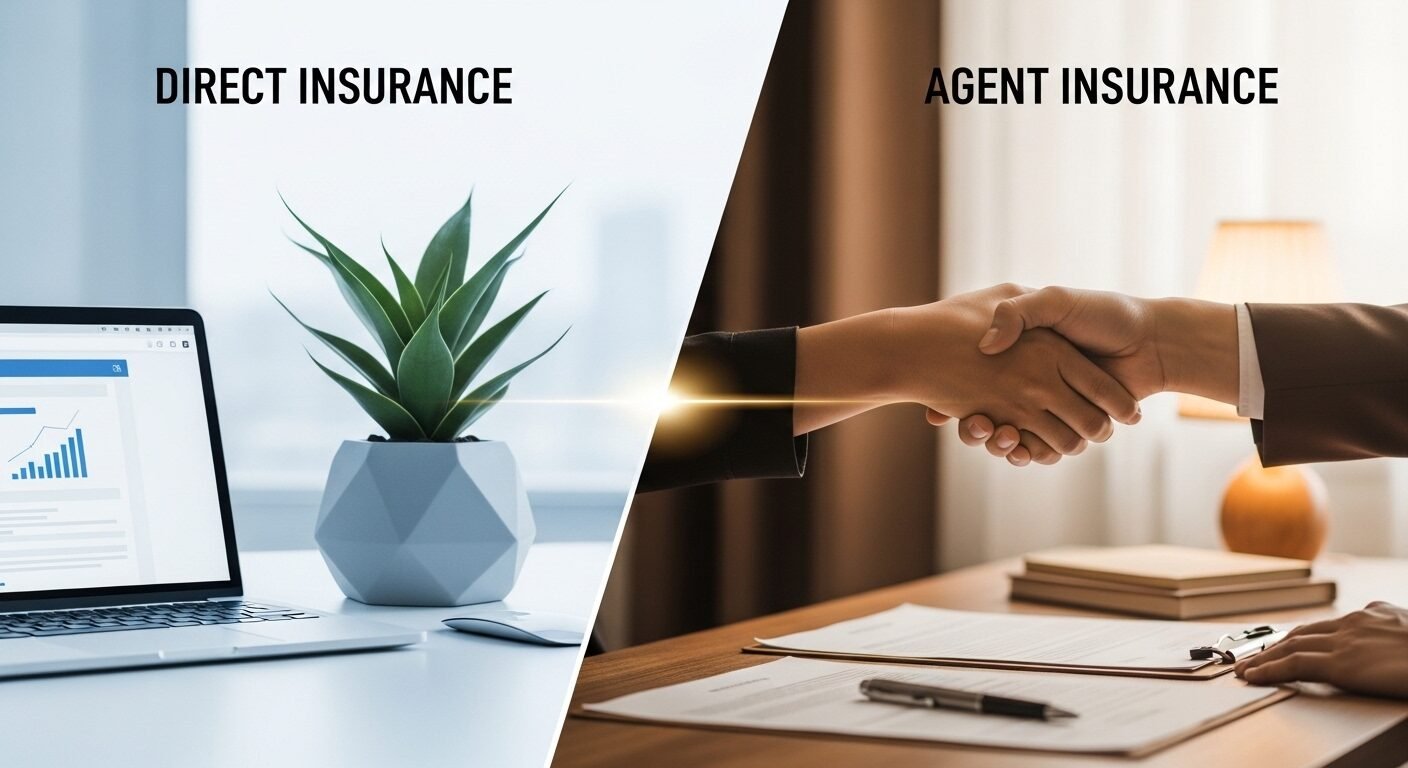
Direct insurance involves purchasing a policy straight from the insurance company, typically via phone or website, with no intermediary. Agent-based insurance uses a licensed professional—either a captive agent representing one company or an independent broker representing many—to help you select and purchase a policy.
The fundamental distinction lies in the sales channel and intermediary involvement. In a direct model, you interact solely with the insurer. This approach is championed by companies like GEICO and Progressive Direct. The agent model introduces a licensed professional who acts as an intermediary. This professional can be a captive agent, such as those working for State Farm, or an independent insurance agent who partners with multiple carriers.
According to industry data from the Independent Insurance Agents & Brokers of America, independent agents place over 80% of commercial insurance and a significant portion of personal lines. This highlights the enduring role of intermediaries in navigating complex coverage landscapes. The choice between these channels affects every subsequent step of your insurance journey.
What Are the Advantages of Buying Direct Insurance?
Direct insurers frequently offer lower initial premiums due to reduced operational costs. This is the most compelling benefit for many consumers. By eliminating commission payments to agents, direct carriers can pass some savings to the customer. The process is often streamlined for simplicity, allowing you to get a quote and bind coverage online in minutes, often outside standard business hours.
You have direct control over the process, which can be appealing for self-directed individuals comfortable with online research. There is no perceived pressure from a salesperson, and you can compare your findings at your own pace. For standard, straightforward policies like basic auto insurance, this model can be highly efficient. Experts recommend this path for those who are price-sensitive, tech-savvy, and confident in understanding their own coverage needs.
What Are the Drawbacks of Direct Insurance Companies?
The primary limitation is a lack of personalized advice and a restricted product menu. You are limited to the products, underwriting rules, and pricing of that single carrier. If your situation is non-standard—such as having a unique home, a specialized business, or a less-than-perfect driving record—you may not find an optimal fit. You must self-diagnose your coverage needs and understand complex policy language without expert guidance.
In the event of a claim, you navigate the process alone, dealing directly with the insurer’s claims department. While many direct companies have robust digital tools, some policyholders report challenges in getting nuanced questions answered or resolving complex claim disputes without an advocate. The burden of comparison shopping across multiple direct insurers also falls entirely on you, which can be time-consuming.
What Are the Benefits of Using an Insurance Agent?
An insurance agent provides expert guidance and advocates for you during the purchase and claims process. This is the core value proposition. A good agent acts as a risk manager, helping you identify exposures you may have overlooked and ensuring your coverage limits are adequate. Independent agents, in particular, can shop your risk profile across their network of insurance companies with a single application.
This one-stop shopping can reveal options and discounts you might not find on your own. They handle the legwork of comparing policies from carriers like Travelers, The Hartford, and Chubb. Furthermore, your agent serves as your point of contact for service changes, renewals, and most importantly, when filing a claim. They can intervene with the insurer to explain circumstances and help ensure a fair settlement.
What Are the Potential Downsides of Agent-Based Insurance?
The cost structure may include commissions, potentially affecting the final premium. While an agent’s market access can find competitive rates, their service is funded by commissions from the insurer. This cost is baked into the policy premium. There is also a dependency on the agent’s expertise, availability, and the strength of their carrier relationships. A less-than-diligent agent might not shop your policy thoroughly at renewal.
Captive agents, representing only one company like Allstate or Farmers, cannot offer products outside their parent company’s portfolio. This limits choice compared to an independent broker. The process may also be slower than clicking online, as it involves communication and back-and-forth. It requires you to place trust in another person’s recommendations, making it crucial to select a reputable, licensed professional.
How to Decide Between Direct and Agent-Based Insurance
- Assess Your Needs: Evaluate the complexity of what you’re insuring. A simple auto policy is different from a business or high-value home portfolio.
- Research Both Channels: Get at least one quote from a direct writer and one through an independent agent for an apples-to-apples comparison.
- Evaluate Service Models: Decide if you value DIY efficiency and control or prefer expert guidance and a long-term advisory relationship.
- Check Reviews and Ratings: Look at financial strength ratings (like A.M. Best) for carriers and customer reviews for both direct insurers and local agencies.
- Make Your Final Choice: Base your decision on the combination of price, coverage scope, company stability, and service support that best fits your situation.
How to Choose the Right Option for You
The best option hinges on a personal evaluation of your insurance knowledge, asset complexity, and service expectations. Consider creating a simple pros and cons list for your specific scenario. For a tech-savvy individual with a clean record insuring a common vehicle, a direct insurer might be perfect. For a family with a home, multiple cars, and an umbrella policy need, an agent’s holistic review could be invaluable.
The standard approach is to not rely on assumptions. Obtain concrete quotes from both channels for identical coverage levels to see the real price difference. Remember, the cheapest policy is not the best if it leaves critical gaps in coverage. Resources like bestinsuranceinfo can provide foundational knowledge, but complex cases benefit from professional consultation. Your choice is not permanent; you can switch channels at renewal if unsatisfied.
| Feature | Direct Insurance | Agent-Based Insurance |
|---|---|---|
| Primary Advantage | Often lower cost, speed, convenience | Expert advice, choice, advocacy |
| Policy Options | Limited to one company’s products | Access to multiple companies (if independent) |
| Personalized Service | Minimal; automated/phone-based | High; dedicated representative |
| Ideal For | Simple needs, price-sensitive buyers | Complex needs, those wanting guidance |
| Claims Support | You deal directly with insurer | Agent can assist and advocate for you |
The Evolving Landscape: Online Brokers and Hybrid Models
Modern options are blending direct and agent models to offer a middle path. The landscape is no longer strictly binary. Online insurance marketplaces and brokers, such as Policygenius or The Zebra, offer a hybrid experience. They provide a direct-like digital quoting engine that aggregates offers from multiple carriers, often with some degree of licensed agent support available via chat or phone.
Research shows a growing consumer preference for these blended digital-first experiences that combine choice with accessibility. Many traditional agent-based firms now offer robust online account management, while direct writers sometimes introduce referral programs to local pros for complex lines. This convergence means you can often get the benefits of comparison shopping with varying levels of human support tailored to your preference.
Frequently Asked Questions
Is direct insurance always cheaper than agent-sold insurance?
Not always. While direct insurers save on commission costs, an